The Disability Inclusion Institutional Framework (DIIF)
The Disability Inclusion Institutional Framework (DIIF) is a conceptual framework and checklist designed to support higher education leadership teams in scaling up Disability Inclusion throughout their organisations and across sectors with all stakeholders.
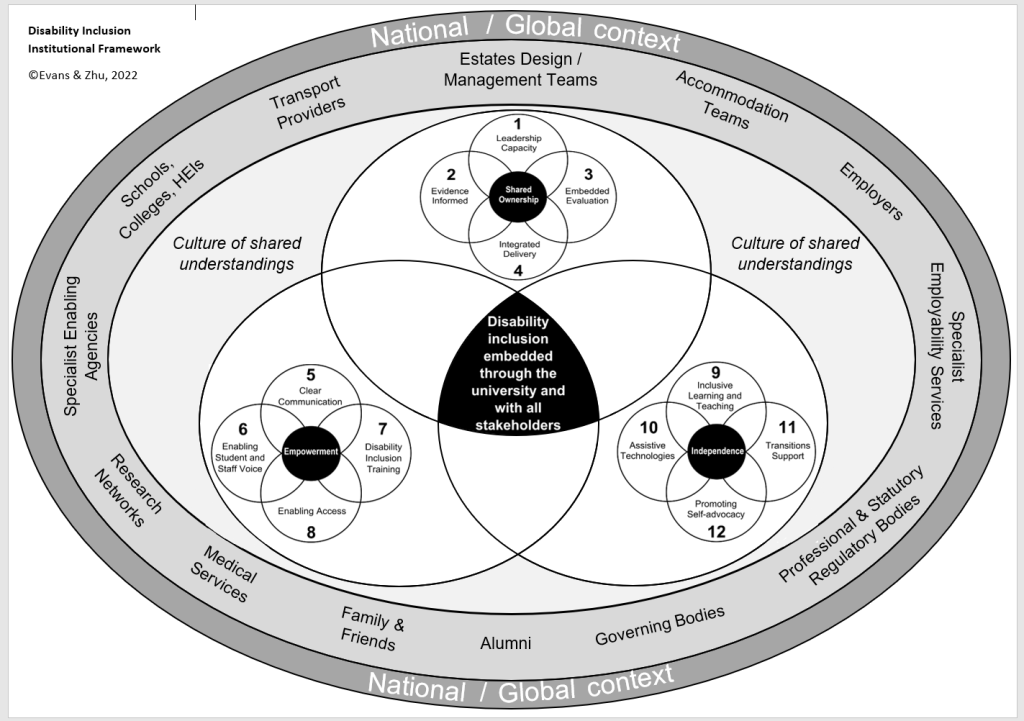
The graphic below provides a visual representation of the 12 themes comprising the DIIF and the interrelated nature of them:
DIIF UK
The Disability Inclusion Institutional Framework (UK) is the outcome of robust systematic review of approximately 500 articles from an initial data base of approximately, 11,000 peer reviewed academic papers on disability inclusion (DI) involving lead authors from 50 countries. Each academic paper was scrutinised for methodological quality, relevance, and transferability (Evans, et. al., 2021), and subjected to thematic analysis using deductive and inductive approaches. Inter- and intra-rater checking was employed throughout to assure findings. Expert reports and associated works (n =100), publicly available institutional data on inclusion, and 8 panel interviews with 37 expert stakeholders were also used in the evolution of the framework.
DIIF International
This version of the DIIF (Int.) has been adapted for International contexts.
The DIIF themes
A summary of the 12 DIIF themes is illustrated in the graphic below:
The 12 DIIF themes are interrelated as demonstrated in the conceptual model.
What works to support disability inclusion in higher education
The what works to suport disability inclusion report undertaken for Transforming Access and Student Outcomes (TASO) is atached below. It provides a thorough analysis of key themes informing the development of the DIIF framework. Information on the summary TASO report and steps forward with this work can be found at the following link: https://taso.org.uk/news-item/report-disabled-students/, and information about the launch of the report is located herehttps://taso.org.uk/event/disability-report/. The initial scope and setting up of this work is reported on here: https://taso.org.uk/news-item/taso-announces-partner-for-new-project-exploring-what-works-to-reduce-equality-gaps-for-disabled-students-in-higher-education/
Integrated Inclusion Framework (IIF)
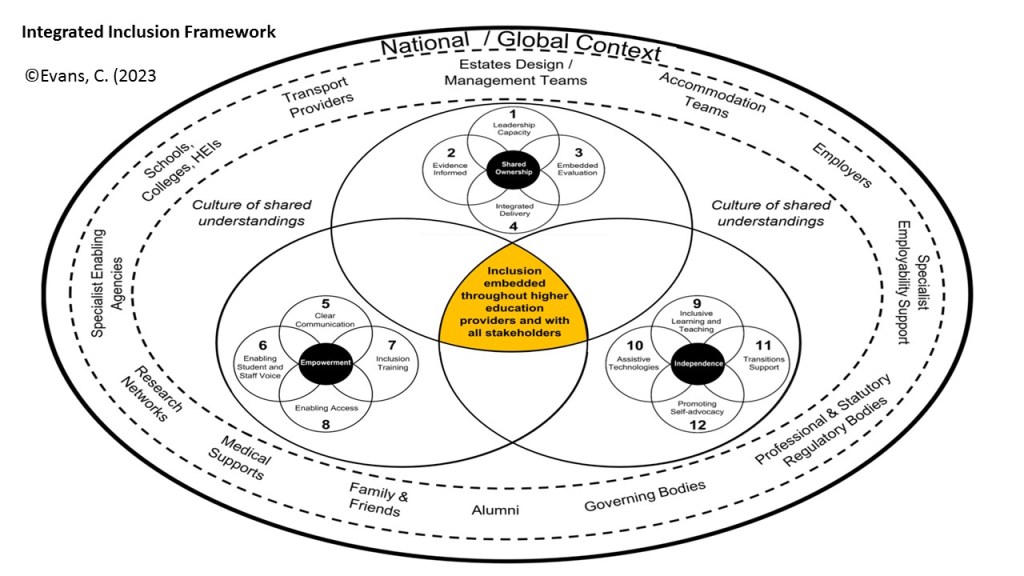
In moving towards an integrated approach to inclusion within higher education, the 12 themes highlighted in the DIIF are relevant in addressing inclusion for all within higher education. Therefore, it is possible to evolve the DIIF into the IIF – an Institutional Inclusion Framework, and work is ongoing to realise this.
A copy of the presentation: ‘Disability Inclusion: Scaling up disability inclusion at the institutional level ‘ (Evans and Zhu (2023) is included below. This was delivered at the Advance HE Equality, Diversity and Inclusion Conference 2023: The Shoulders of Giants: Listening, Learning and Improving our Practice, on 15 March, 2023 can be found below.
The presentation used at the launch of the DIIF at the University of Lincoln’s Eleanor Glanville Institute is attached below.
A Shared Advocacy Approach to Disability Inclusion
The Shared Advocacy Resource for Supporting Disability Inclusion evolves understanding of self-advocacy to explore the role of organisations in supporting the agency and autonomy of disabled persons. The resource outlines a model of shared advocacy to support disability inclusion in higher education. This resource is a shared collaboration between The British Council and University of Lincoln. The frameworks and tools outline an approach that highlights mutual adjustments made by a person with disabilities and higher education providers as part of a shared advocacy model to ensure inclusive provision for staff and students with disabilities in higher education.
British Council Disability Inclusion Resources
The documents below were developed to support the British Council’s Disability Inclusion Initiative in conjunction with colleagues at the Eleanor Glanville Institute, University of Lincoln as an introduction to the key principles underpinning the DIIF Framework. The principles were considered in specific cultural contexts to look at how best to evolve them to work best with local stakeholders as part of the drive to support enhancements in disability inclusion across regions.
Disability Inclusion Principles
The principles set out below were developed through consultation with colleagues across the HE sector and through extensive review of the literature and underpin the DIIF. Agreeing shared principles underpinning disability inclusion is central to strategy development.
Exploring Facilitators and Barriers to Disability Inclusion
This task supports you in looking at factors that both support and hinder disability inclusion within your context and is a useful starter exercise to undertake with key stakeholders to explore different positions on this.
Perceptions of organisational effectiveness in achieving disability inclusion
This one page document provides a useful guide to explore organisational effectiveness in relation to the DIIF dimensions of effective practice in higher education. Bespoke versions have been developed for specific organisations. For more detailed analysis, the DIIF framework can be used to critically review each of the 12 key dimensions of effective DI practice within organisations.
Supporting International Students with Disabilities (ISwD) UK Higher Education Transitions
This resource was commissioned by the British Council and summarises key findings from a survey of British Council international alumin students with disabiities (ISwD) experiences of higher education in the UK. It identifies key priorities for universities to best support ISwD that can also benefit all students.
Exploring International Students with Disabilities (ISwD) experiences of UK higher education
This presentation summarises preliminary findings from a pilot survey of international students with disabilities that was undertaken with the University of Lincoln for the British Council.
Promoting Inclusion for all students: an integrated theory of change model
Promoting inclusion for all: An integrated theory of change model
To support the inclusion agenda, this report outlines and integrated equity, diversity and inclusion model for organisations and approaches to developing a research-informed appproach to change. This work was undertaken with the University of Lincoln and was commissioned by the British Council to support EDI initiatives within their Science and HE programmes. Developing a clear and robust theory of change to support such work is covered within the document.
Developing an EDI Theory of Change
This presentation highlights key considerations in developing a theory of change to support inclusion. The approach can be applied at different scales (e.g., programme change; organisational change).
Disability Inclusion for Students Studying in UK Higher Education: Report for the British Council
This presentation provides an overview of the report for the British Council on Disability Inclusion for Students in the UK. The full report can be found here, and webinar recap here.
Enhancing Disability Inclusion for All: Learning from the Lived Experiences of Higher Education Staff with Disabilities
The presentation uploaded below was delivered at the AMOSSHE conference on 3 July 2025. It presents result from the first ever national survey of staff with disabilities in the UK based on the DIIF framework and for a Realising Inclusion for Disabled Employees in Higher Education (RIDE Higher) Initiative for NADSN.
NDSS Australia
 Inclusive he